
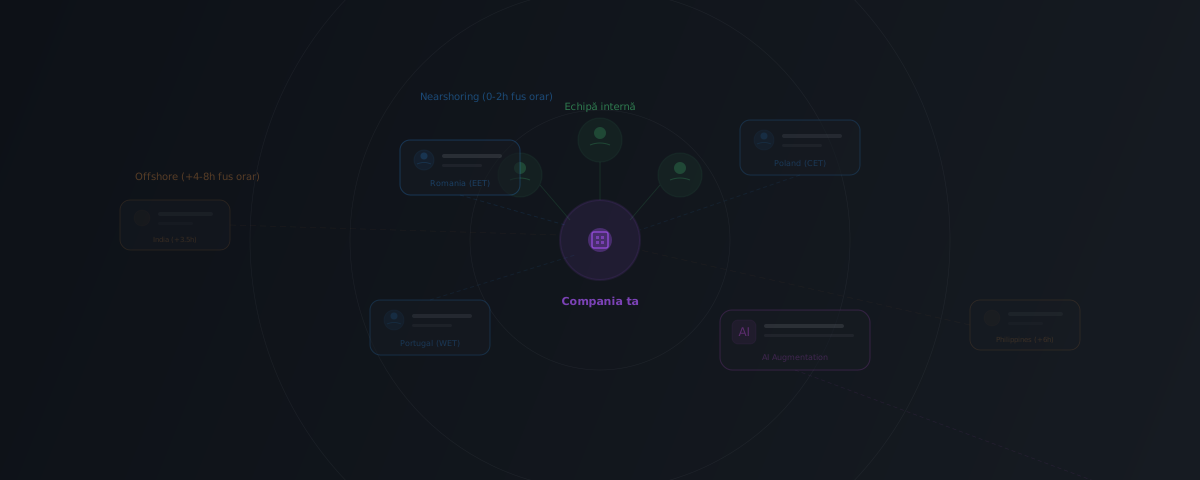
You need a digital product built. The question isn't just what you're building, but who builds it.
The options have multiplied: in-house team, offshore outsourcing, nearshoring, freelancers, distributed teams, AI-augmented models. Each comes with real trade-offs that affect your budget, speed, quality, and control.
In short: AI amplifies productivity, but doesn't replace good developers.
Work Models at a Glance
In-House Team
You hire full-time developers on your company's payroll.
Advantages:
- Maximum control over priorities and process
- Deep knowledge of the business and the product
- Immediate availability and long-term loyalty
- Direct communication, no intermediaries
Disadvantages:
- The real cost includes more than salary: taxes, benefits, equipment, management, and recruitment
- Hard to scale: you can't quickly hire/fire based on project needs
- Skills gap risk: if you need Flutter today and Go tomorrow, your team might not cover both
Best for: companies with a long-term product, stable teams, HR budget.
Offshore Outsourcing
You outsource development to a company in a different geographic region (usually cheaper): India, Philippines, Bangladesh, Ukraine.
Advantages:
- Access to a large developer pool
- Fast scaling (the partner's team already exists)
Disadvantages:
- Cultural barriers — different communication styles, different quality expectations
- Quality risk — pressure for low prices sometimes attracts junior teams
- Loss of control — you don't see how work is done day-to-day
- Intellectual property — different legislation, NDAs harder to enforce
Best for: well-defined projects with stable requirements, where cost is the priority.
Nearshoring
You outsource to a company in the same geographic/cultural zone. For Western European companies: Romania, Poland, Czech Republic, Bulgaria, Portugal.
Advantages:
- Cultural proximity — similar work style, aligned expectations
- Moderate costs — lower than in-house in Western EU, but comparable quality
- EU legal framework — GDPR, shared regulations, enforceable NDAs
Disadvantages:
- More expensive than offshore
- Same risk of dependency on an external vendor
- Requires relationship management
Best for: EU companies that want optimized costs without sacrificing quality or communication.
Team Augmentation (Staff Augmentation)
The external vendor provides individual developers who work embedded in your team, under your management.
Advantages:
- Direct control over the work (like an employee, without the HR overhead)
- Flexibility — add/remove people quickly
- The developer understands the product deeply (works with your team daily)
Disadvantages:
- Dependency on an individual (if they leave, you lose context)
- Management stays with you (you need an internal tech lead)
- Costs can be comparable to direct hiring
Best for: in-house teams that need temporary additional skills.
Freelancers
Independent developers hired per project or per hour.
Advantages:
- Maximum flexibility, zero long-term commitment
- Access to niche specialists
- Variable costs (you only pay when you need them)
Disadvantages:
- Uncertain availability — the freelancer has other clients too
- Zero redundancy — if they're sick or unavailable, the project stalls
- Continuity risk — if they leave, who takes over the code?
Best for: one-off tasks, prototypes, small projects with a fixed scope.
Romania as a Nearshoring Destination
Romania has established itself as one of Europe's strongest software development markets:
- Strong technical skills — well-regarded technical universities, solid engineering culture
- EU member — GDPR, European legal framework, freedom of movement
- Professional-level English — high fluency rate in IT
- Tech hubs — Bucharest, Cluj-Napoca, Timisoara, Iasi
AI Augmentation: What's Changing in 2026
AI doesn't replace development teams, but it makes them more productive. The concrete impact:
What AI Already Does Well
- Boilerplate code generation — setups, CRUD, standard integrations
- Automated code review — detecting vulnerabilities, performance issues, inconsistencies
- Testing — unit test generation, edge case discovery
- Documentation — automatic documentation generation from code
- Debugging — error analysis, fix suggestions
What AI Does NOT Do Well
- Architecture decisions (what stack to use, how to structure modules)
- Understanding business context (which feature matters most)
- Stakeholder communication (aligning expectations)
- Complex trade-offs (performance vs. cost vs. deadline)
- Mentorship and team growth
The Real Impact
AI amplifies competence; it doesn't create it. A junior with AI writes code faster, but doesn't make better architecture decisions.
How to Choose: A Decision Framework
Question 1: What's the project maturity?
- Idea / validation → freelancer or small team (nearshoring)
- MVP / launch → dedicated nearshoring team
- Growth / scaling → in-house team + nearshoring for expansion
- Maintenance → small in-house team + external support as needed
Question 2: How clear is the scope?
- Very clear (fixed requirements, one-time delivery) → outsourcing with a fixed price works
- Evolving (agile, iterative MVP) → a dedicated team (in-house or nearshoring) works better
Question 3: How important is control?
- Critical (fintech, healthcare, sensitive data) → in-house team or nearshoring with strict NDA
- Moderate (B2B SaaS, internal apps) → nearshoring with active management
- Flexible (MVP, proof of concept) → any model works
Red Flags with External Vendors
Regardless of the model, watch out for:
- They don't ask questions — a good vendor challenges you on requirements, they don't blindly accept everything
- They promise everything — "yes, we'll do anything, on any timeline" is a red flag
- They won't show code — they don't want to show a portfolio or refuse code review
- Slow communication — if they're hard to reach before the contract, it'll be worse after
- No clear process — they have no methodology (Agile/Scrum), no periodic reporting
- The team is a mystery — you don't know who's working on your project
For what to check when switching an existing vendor, read the transition guide.
The Brainic Model
Brainic is a founder-led studio based in Romania. Silviu leads architecture and delivery, with specialists involved according to the project's needs:
- Direct communication — you discuss technical decisions and progress with Silviu
- Transparent process — we agree on how to track progress and demonstrate results
- Clear responsibilities — we agree on who works on the project and how any changes are communicated
- Agreed availability — we establish allocated capacity and collaboration hours before committing
- Clear access and handover — we agree on repository access, deliverable ownership, and the documentation needed
Whether you're starting from scratch, taking over an existing project, or looking for support for your team, we can discuss a technical collaboration. We agree on the role, responsibilities, and availability before committing.