
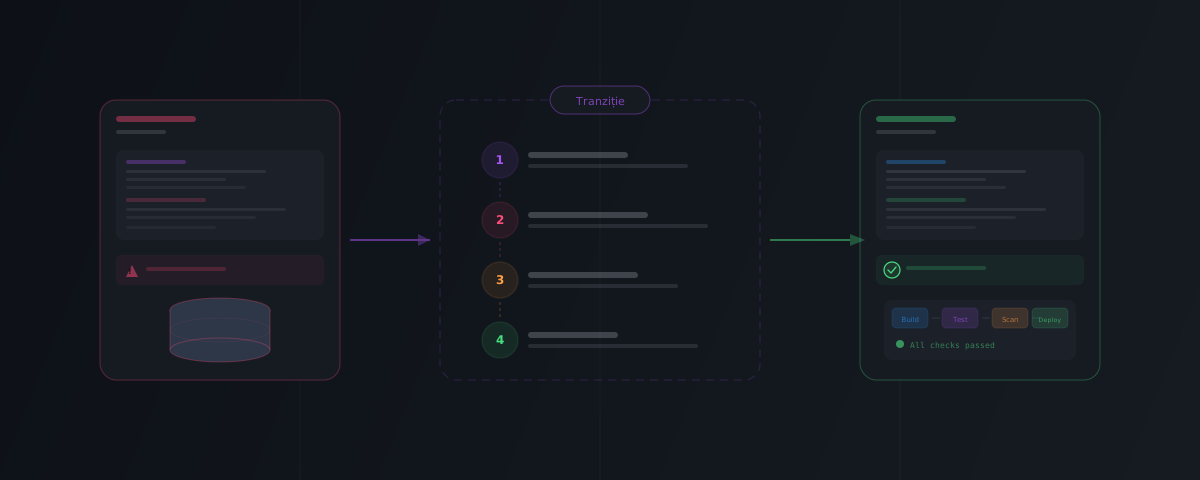
The decision to switch development teams is never easy. It usually comes after months of frustration: missed deadlines, quality below expectations, poor communication, or simply the need for skills the current team doesn't have.
The problem: switching vendors is a project in itself. Done poorly, you can end up in a worse situation than before. Done right, it's a solid fresh start.
In short: Transitioning from one software vendor to another requires a clear plan: code audit, documentation, a takeover plan, and stabilization. The biggest risks are losing access to code and underestimating the takeover effort. Make sure you own all accounts and repositories.
When It's Time to Switch Vendors
A few warning signs:
- Deadlines are consistently missed — not once, but systematically, sprint after sprint
- Code quality is declining — frequent bugs, regressions, fragile code that "breaks" with any change
- Communication is difficult — you don't get clear answers, you don't understand what's happening, you have no visibility
- The team doesn't understand your business — they implement exactly what they're told, without thinking
- Costs are rising without proportional value — you're paying more, but not getting more
- Lack of proactivity — risks aren't flagged, alternatives aren't suggested, nothing is optimized
Step 1: Understand Your Own Project
Before talking to a new team, make sure you can answer these questions:
Technologies
- What languages/frameworks are used? (e.g., Flutter, React Native, Swift, Kotlin)
- What backend stack? (Node.js, Laravel, Django, .NET, Go)
- What databases? (PostgreSQL, MongoDB, Firebase, etc.)
- What cloud services? (AWS, Google Cloud, Azure, Cloudflare)
Infrastructure
- Where is the application hosted? (cloud, on-premise, PaaS)
- Are there CI/CD pipelines? (GitHub Actions, GitLab CI, etc.)
- How are deployments done? (automated, manual)
- What third-party services are integrated? (Stripe, Firebase, Twilio, etc.)
Ownership and Access
- Do you have access to the source code? It should be in your repository, not the vendor's
- Do you have access to hosting accounts, domain, SSL certificates?
- Do you have access to App Store / Google Play accounts?
- Does documentation exist? Is it up to date?
Important: if you don't have access to code or infrastructure, resolve this before announcing the transition.
Step 2: Preparing the Documentation
The ideal document to hand over to the new team:
Mandatory
- Source code — complete repository with commit history
- Requirements specs — what the application should do (even if incomplete)
- Credentials — access to all services (hosting, API keys, databases, store accounts)
- Database schema — data structure and relationships
- Configuration files — environment variables, deployment config
Ideal
- Architecture documentation (how modules are organized, how they communicate)
- Local setup guide (how to run the project on a development machine)
- Critical flow descriptions (authentication, payments, notifications)
- Bug tracker / current backlog (what's in progress, what's planned)
- Design files (Figma, Sketch, Adobe XD)
If No Documentation Exists
Not ideal, but not unusual. A competent team can reverse-engineer an existing codebase. It will take longer and cost more — but it's feasible.
Step 3: Code Audit (Code Review)
The most important stage of the transition. The new team analyzes the existing codebase and evaluates:
What a Code Audit Checks
- Code quality — is it structured, readable, does it follow conventions?
- Testing — do tests exist? What's the coverage?
- Security — known vulnerabilities, hardcoded sensitive data, problematic dependencies
- Performance — slow queries, memory leaks, inefficient code
- Technical debt — how much code needs to be refactored vs. how much is reusable
- Dependency updates — outdated versions with vulnerabilities, deprecated libraries
Audit Results
A structured report with:
- Overall state of the codebase (healthy / needs intervention / critical)
- Critical issues requiring immediate remediation
- Estimated technical debt (effort needed to bring the code up to standards)
- Recommendations — what to keep, what to refactor, what to rewrite
- Effort estimate for takeover and continuation
Step 4: The Transition Plan
Best-Case Scenario: Team Collaboration
The old team does knowledge transfer while the new team gradually takes over. It's the most efficient approach, but it requires the old vendor's cooperation.
Realistic Scenario: Key Handover
The old vendor hands over the code and documentation, the new team audits and takes over independently. Slower, but it works even without the old team's cooperation.
Difficult Scenario: Zero Cooperation
The old vendor won't cooperate or disappears. The new team works exclusively with the existing source code and access credentials. Costly, but feasible if you own the code.
Step 5: The Stabilization Period
- Set up the development environment, run locally, understand the architecture
- Make critical fixes, set up CI/CD if it does not exist, and make the first code contributions
- Refactor where needed, then establish a stable delivery cadence
Don't try to "catch up" in the first weeks. A team that thoroughly understands the codebase delivers faster in the long run than one that writes chaotic code from day one.
Things That Can Go Wrong (and How to Prevent Them)
1. Losing Access to Code or Infrastructure
Prevention: make sure you own all accounts (repository, hosting, store accounts). Not the vendor.
2. Undocumented Spaghetti Code
Prevention: budget for a code audit before signing with the new team. You'll know exactly what you're taking on.
3. The Old Team Sabotages the Transition
Prevention: announce the transition professionally. Offer a paid transition period. Include cooperation clauses in the contract.
4. The New Team Wants to Rewrite Everything from Scratch
Prevention: this is rarely justified. Most of the time, incremental refactoring is more effective. Demand concrete arguments for any rewrite.
Legal Aspects to Verify
- Intellectual property — does the contract with the old vendor clearly state that you own the code?
- NDA — does the old team have post-contract confidentiality obligations?
- Licenses — is the software used (libraries, services) licensed under your name or the vendor's?
- GDPR — if the old team had access to personal data, are there data deletion obligations?
How Brainic Handles Transitions
Depending on the project's condition and the agreed scope, a collaboration may include:
- Initial conversation — we understand the situation and assess fit
- Code audit — detailed analysis of the existing codebase, with a report and recommendations
- Transition plan — timeline, stages, clear responsibilities
- Stabilization — takeover, critical fixes, and process setup
- Ongoing development — after stabilization, we can discuss continuing with the feature backlog
A technical assessment can remain a standalone engagement. We present findings, assumptions, and known risks; estimated effort can change as new information emerges.
Have a project you want to move to a new team?