
You have an idea for a digital product. You have validated it (or at least you think you have). Now the question: where does the money come from?
Funding a software product does not necessarily mean finding an investor. There are multiple paths, each with its own advantages and trade-offs. This guide covers all of them — from bootstrapping to Series A.
In short: A digital product can be funded through bootstrapping, grants (SME Digitalization, Start-Up Nation), angel investors, or pre-sales. The choice depends on the stage of your idea and how much control you want to keep. The most pragmatic approach: start with an MVP funded from your own revenue, then scale.
Before Looking for Money: What You Need to Have Ready
Regardless of the funding source, investors (or you yourself, if you are bootstrapping) need answers to:
- What problem do you solve? — clear, specific, validated
- For whom? — a defined market segment
- How do you make money? — revenue model (SaaS, marketplace fee, freemium, etc.)
- How much does development cost? — a realistic estimate, not "we'll see"
- What have you proven so far? — validation, MVP, first users, revenue
The more concrete evidence you have, the more funding options open up.
Funding Stages
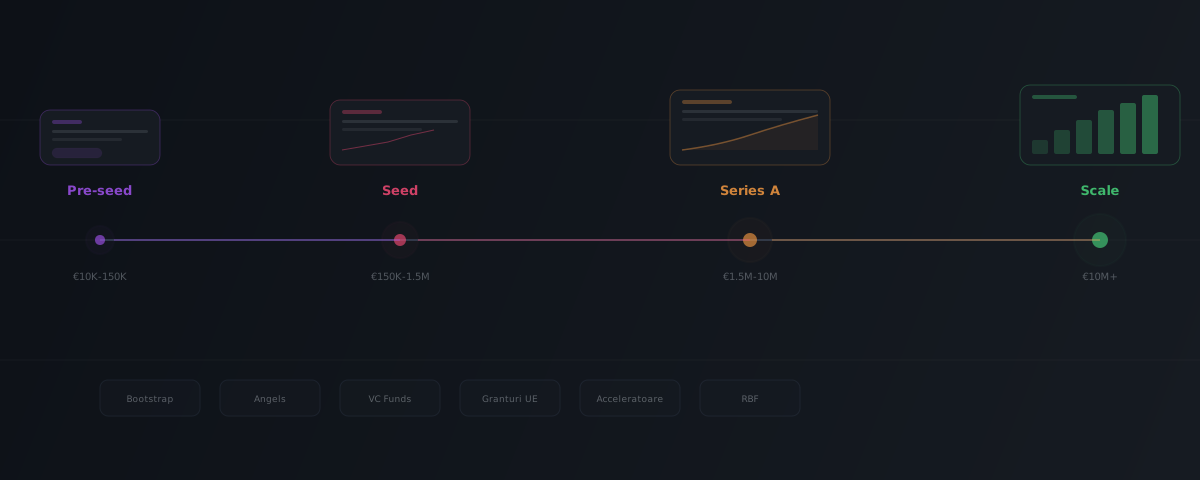
Pre-seed (Idea + Validation)
- Purpose: market validation, MVP, first users
- Sources: personal savings, friends & family, angel investors, pre-seed funds, grants
At this stage, you are not funding a company — you are funding a hypothesis. Investors at this stage invest in the team and the potential, not in metrics.
Seed (Product + First Customers)
- Purpose: product-market fit, first revenue, team growth
- Sources: angel investors, seed-stage VC, accelerators, revenue-based financing
At seed, you need to demonstrate that the product works and that there are customers willing to pay. Metrics matter: MRR, retention, customer acquisition cost.
Series A (Scaling)
- Purpose: scaling, expansion into new markets, team growth
- Sources: VC funds, corporate venture capital
- Requirements: proven product-market fit, recurring revenue, positive unit economics
Series A is no longer about potential — it is about demonstrated execution.
Funding Sources in Detail
1. Bootstrapping (Self-funding)
You build with your own resources, from savings or from the revenue of another activity.
Advantages:
- Total control — you give up no equity, have no board, no external pressure
- Fast decisions — you do not wait for approvals
- Financial discipline — you only spend what you have
Disadvantages:
- Slow growth — a limited budget restricts your speed
- Personal risk — the losses are yours
- Hard to scale — without external capital, some opportunities pass you by
Works best for: SaaS with low initial costs, niche products, founders with alternative income streams.
2. Friends & Family
Money from relatives, friends, or acquaintances. The most accessible source, but also the riskiest in terms of relationships.
Essential rules:
- Treat it as a formal investment — written contract, clear terms
- Only invest what they can afford to lose (and tell them that explicitly)
- Define whether it is a loan (to be repaid) or equity (they become co-owners)
3. Angel Investors
Individual investors who put their own money into early-stage startups.
What an angel looks for:
- A competent and committed team
- A real, validated problem
- A large enough market
- Exit potential (acquisition or IPO)
4. Venture Capital Funds
Professional funds that invest managed money (from LPs — limited partners). They invest larger amounts, but demand aggressive growth and an exit.
What a VC looks for:
- Proven metrics: MRR, growth rate, retention, LTV/CAC
- A team capable of executing at scale
5. Accelerators and Incubators
Relevant programs:
- Y Combinator (global, remote-friendly)
- Techstars (global)
- Seedstars (emerging markets)
- InnovX (Bucharest)
- Techcelerator (Bucharest)
The biggest advantage is not the money, but the network of mentors and investors you gain access to.
6. Grants and Non-repayable Funding
Funding that does not require giving up equity or repayment.
Sources available:
- Digital Europe Programme (EU) — funding for AI, cybersecurity, digital skills
- Horizon Europe — research and innovation, collaborative partnerships
- NRRP / structural funds — SME digitalization, programs like "Startup Nation" (check the active calendar)
- EIC Accelerator — grants below EUR 2.5M and equity investments of up to EUR 10M
Disadvantages: bureaucratic process, long approval times, detailed reporting requirements.
7. Revenue-Based Financing (RBF)
An alternative model: you receive capital and repay a percentage of your monthly revenue, up to a pre-set cap.
Advantages:
- You do not give up equity
- Payments adjust to revenue (slow months = smaller payments)
- Fast process (days, not months)
Disadvantages:
- Total cost is higher than a bank loan
- Requires existing recurring revenue
- Does not work for pre-revenue startups
Platforms: Uncapped, Pipe, Re:cap (Europe).
Common Mistakes
1. Seeking Funding Too Early
If you have not validated the idea, money will not fix anything — it only delays the moment you discover the product has no market. Validate first with market research.
2. Not Knowing the Real Costs
"I want EUR 500K for development" without a detailed breakdown convinces nobody. Do a realistic estimate and present it in a structured way.
3. Ignoring Unit Economics
Investors want to see: how much it costs to acquire a customer (CAC), how much they are worth over their lifetime (LTV), and how long it takes to recover the acquisition cost (payback period). If you cannot answer these, you are not ready for seed.
4. Pitching Without a Demo
A pitch deck without a demo or prototype is abstract. Show the product — even an interactive wireframe is more convincing than 40 slides.
Pitch Deck: The Essential Structure
- Problem — what pain point you solve
- Solution — what you are building
- Demo/Screenshot — show the product
- Market — how big the opportunity is (TAM/SAM/SOM)
- Business model — how you make money
- Traction — what you have demonstrated (users, revenue, growth)
- Competition — who else is in the market and how you differentiate
- Team — why you are the right people
- Financials — projections
- Ask — how much you are raising and what for
How We Can Help at Brainic
We can discuss a product idea, an MVP, or a prototype, with or without AI. Depending on the context and agreed scope, a collaboration may include:
- Discovery and estimation — deliverables, assumptions, risks, and an estimate by module;
- MVP — a limited version that tests the hypothesis with real users;
- Prototype — a representation of the product for feedback and conversations with potential investors.
Brainic is not an investment fund. Development or a prototype does not guarantee demand, market validation, or funding; the aim is to gather information for the next decision.